Oh, sloth. What is it about you that brings so many people so much joy? Is it your sly smile? Your fuzzy cuddle-ability? Or is it your sluggish movement that reminds us of our inner lazy bums? Whatever it is, I’m hooked. It’s one of the things that drew me to visit Costa Rica this winter.
The sloth remains one of the most well-liked animals in the U.S., a favorite among my friends’ children and among my unabashedly obsessed grown-up friends, and of course there’s Kirsten Bell’s famous 2012 sloth meltdown on Ellen. Despite their popularity here, sloths are not native to North America. They can be found in various Central and South American countries, and are perhaps best known as coming from Costa Rica due to a great marketing campaign and the relative ease of seeing them in the wild there.
And so I found myself in Costa Rica for a month-long trip over the holidays and new year, where I went to enjoy the nature and see as much of the country as I could; and hopefully spot a sloth or two.
The bulk of the trip was spent with a small group tour with the company G Adventures, aptly called “Costa Rica Adventure.” As we gathered in the hotel lobby to meet our tour group for the next two weeks, our guide, a 24-year old powerhouse Tica (Costa Rican) named Sophia, asked an icebreaker: “What is one thing you are hoping to see or do while you are here?”
Clodagh from Ireland answered first: “I’m interested in experiencing the nature and biodiversity,” she shared. Her husband, Finnbarr, was next, and immediately stole my answer, “I want to see a sloth!” Lots of nodding all around. I echoed his answer, and I wasn’t the only one in our group of 15, with others mentioning the adventure activities and monkeys. Still, I tried to keep my expectations low, knowing that wildlife sightings are never a sure-thing.
I’m thrilled to report I was not disappointed.
Manuel Antonio
The first sighting was on day 3. The location: Manuel Antonio National Park, the most visited natural area in Latin America after Machu Picchu in Peru, located toward the southeast on the Pacific coast. It was peak tourist season as we approached the holidays, and the crowds were something to be reckoned with. We arrived at the entrance gate a few minutes before the park opened for the day, and already were assaulted with vendors pushing tchotchkes on us and a long line. The entrance line took a while, as guests are not allowed to bring in any food or single-use plastic items, including things like sunscreen bottles or bug spray in order to protect the ecosystem. I forgot a few small purse items in my daypack and stuffed them into my bra, successfully evading their surrender.
We met our guide Javier, bunching together amidst bunches of other groups and their guides. We began our walk along the park’s trails, stopping early and often to ogle iguanas, agouti, birds, bats, and other critters, all the while competing for space with the other groups. It didn’t take long until we saw a couple of groups gathered together on a wide part of the path. “What is it?” we all asked. And lo and behold, our first sloth sighting.
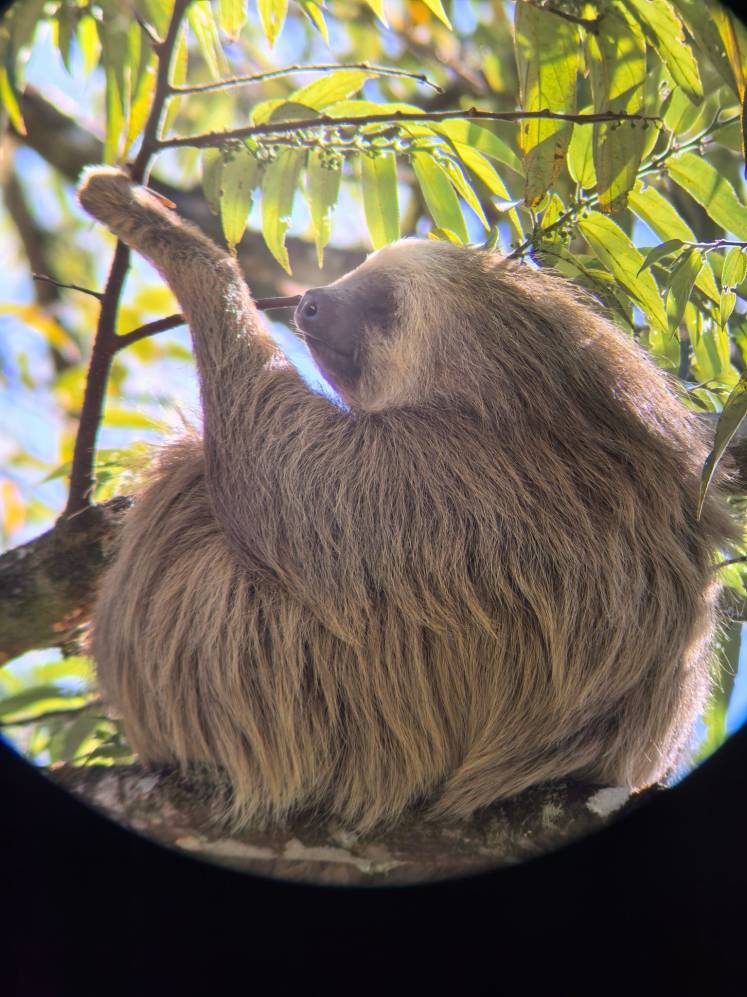
Javier had a fancy telescope that allowed you to attach an iPhone for super-zoomed-in views, and we all gathered around to see, so we could see details like the dark eye stripes and long toenails. But even without the zoom lens I could see the sloth, who was moving across a branch about 20 feet up. I was surprised by how fast it was moving, exposing its long arm reach and skinny, furry torso, the sense of determination visible even from afar.
Javier shared some sloth facts with us, distinguishing between two- and three-toed species and noting that most are female. They’re also pretty solitary, keeping to their own territory. The fact that most stayed with me: sloths generally stay up in the trees to evade predators, but they’ll come down to the ground about once a week to poop!
We spotted two more sloths in Manuel Antonio, though both were further away and not moving, and the last one I didn’t really see at all without the phone zoom. Sloths spend a lot of time sleeping, making them tricky to spot.
The tour ended at a beach; a perfect, perfect beach, with white sand, warm water, and totally encased in nature on the edge of the jungle. We didn’t have much time left before we had to depart for our next destination, but we managed to get in a nice swim. While a few of us were in the water, we looked back to the shore to see a white-faced capuchin monkey running around under the trees, poking into people’s bags and eliciting screams and shooing reactions. And we noticed our tourmate Alice from California, blissfully seated on a log staring off into the water, as a monkey dropped down to the left of her head looking at her, Pirates of the Caribbean movie style. “ALICE!” we tried to yell in warning, eventually eliciting a mutual startling of monkey and human as it ran off into the jungle.
The Parking Lot
In La Fortuna, one of the most popular tourist destinations in the country known for its epic waterfalls, hot springs, and adventure activities, serendipity led us to see lots of wild sloths in unexpected ways.
Following the lead of other cars, we pulled the van over to the side of the main road at least 3 times to get out and look at sloths in trees on the side of the road, not worrying about the traffic backup we were contributing to. They were a little hard to see, but at one of the sightings, Kate from England let me borrow her trusty binoculars. I was grateful, because that one had a baby with it!
At our hotel property, we spotted a sloth hanging out in a tree at night, and again during the day. I was proud for finally being the one to spot the sloth on our last morning there, showing a passing man as the two of us spent a few minutes watching the snoozing creature.
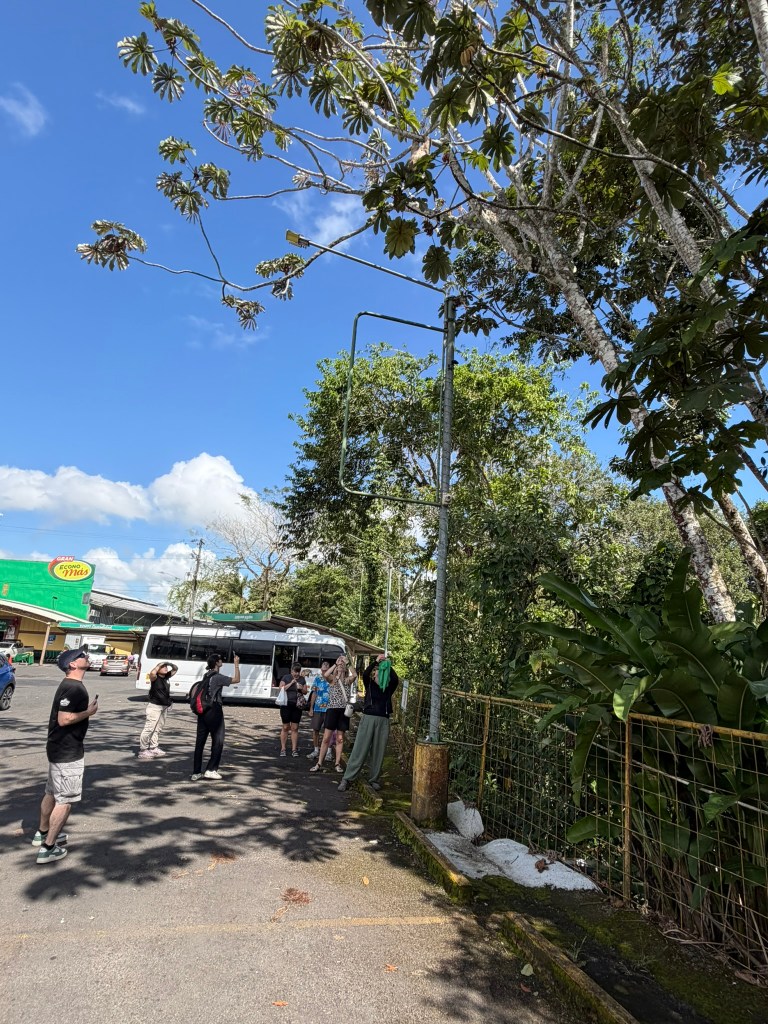
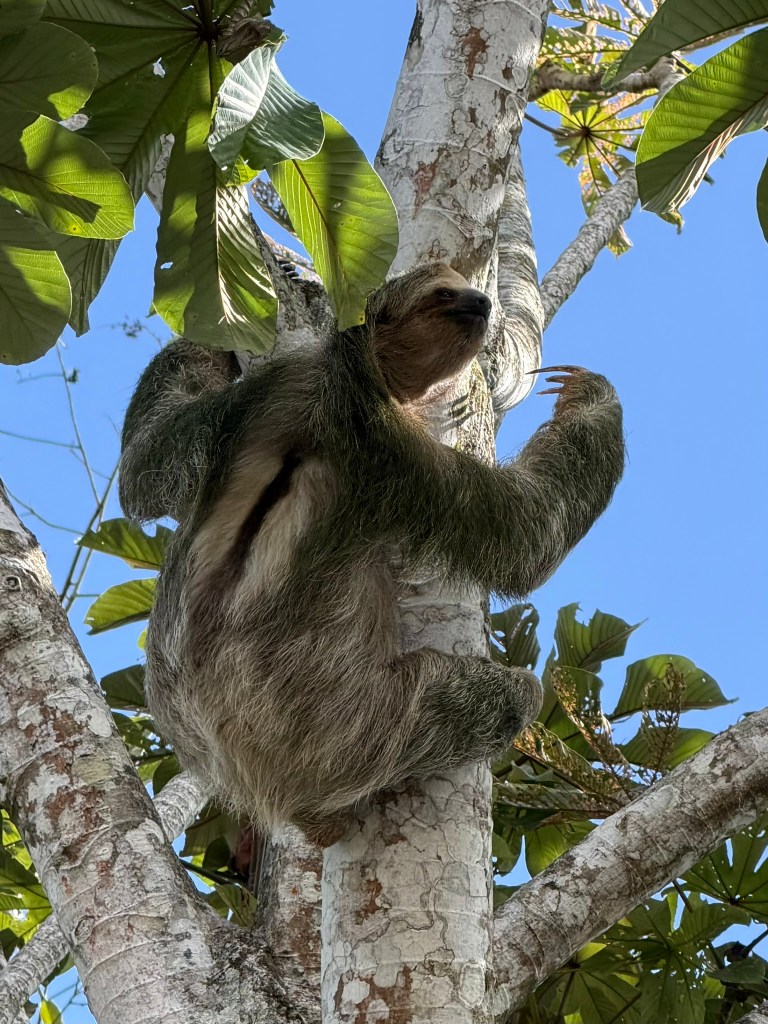
On our way out of town and to our next location deep in the jungle, we made a pit stop at a grocery store to load up on snacks and beers. Good, because I was running low on plantain chips. As we trickled back out to the minibus in the small parking lot, Sophia alerted us to a sloth, who was dangling stunningly close to our vehicle and moving around at an energized pace (for a sloth). We were so close – at times it was nearly eye level. We could see its facial details and the dark stripe on its back, and its chubby little tushy as it climbed up and down the branches. We lost all sense of time in awe of the sighting, until Sophia gave a gentle, “Okay guys, I know we could stay here all day, but we’ve got places to be.”
The Coconut Tree
Our tour took us to the Caribbean coast, a less-visited and more remote part of the country. To get to Tortuguero, a coastal town without motorized vehicle access, we jammed our luggage into a long boat in the town of La Pavona and enjoyed an hour-long canal navigation. We passed two caimans—a scary, sharp-toothed cousin of the crocodile—and lots of beautiful birds.
As we docked in the center of town, I instantly felt the chill Caribbean town vibes. While the town’s draw is a national park and seasonal turtle nesting, it felt like more than just a tourist destination, as we passed a school and saw locals more than in other destinations. It took just 10 minutes to walk through the entire main street of the town, passing some bars, restaurants, and shops. It was all colorful vibes and turtle themed.
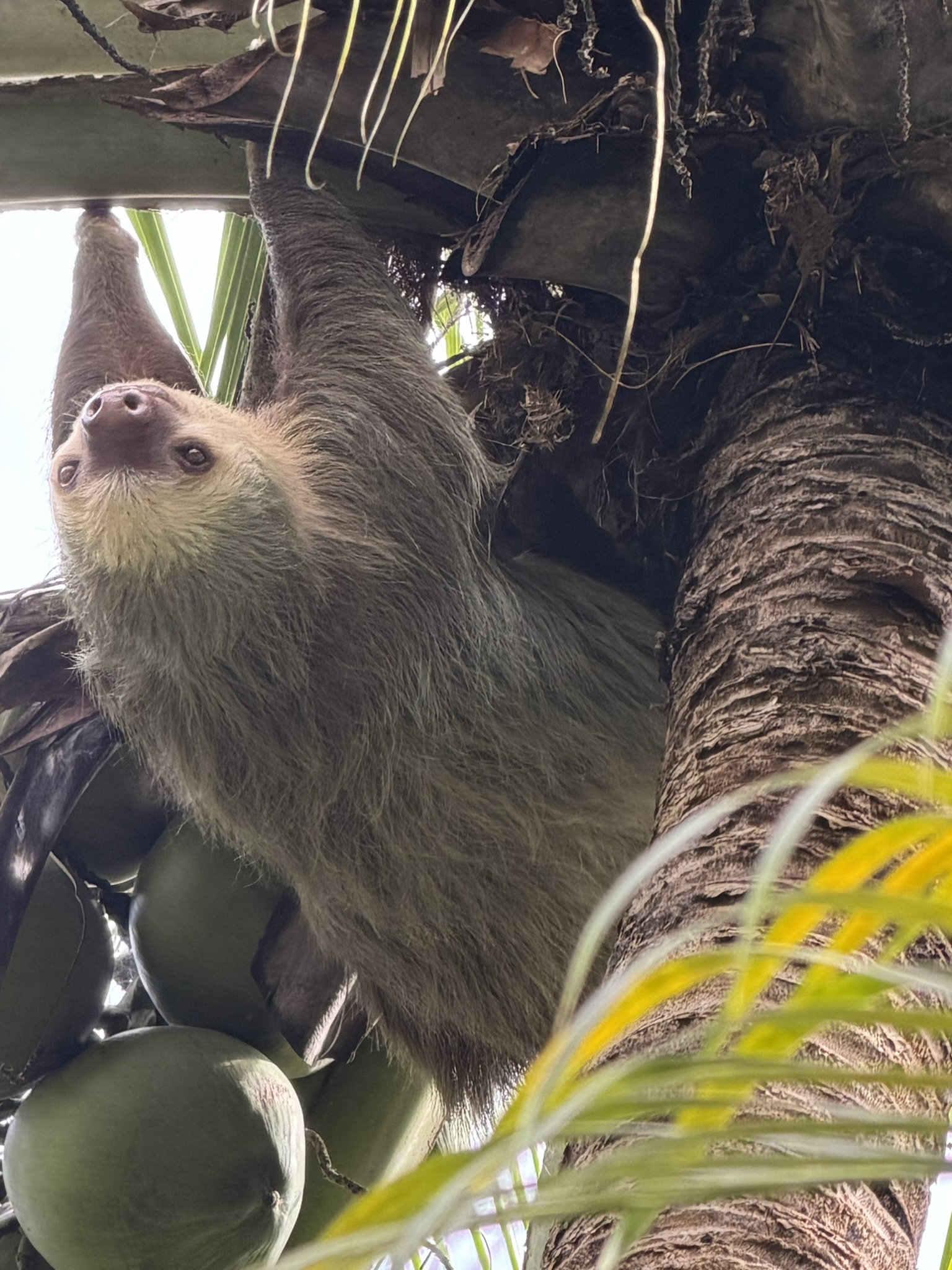
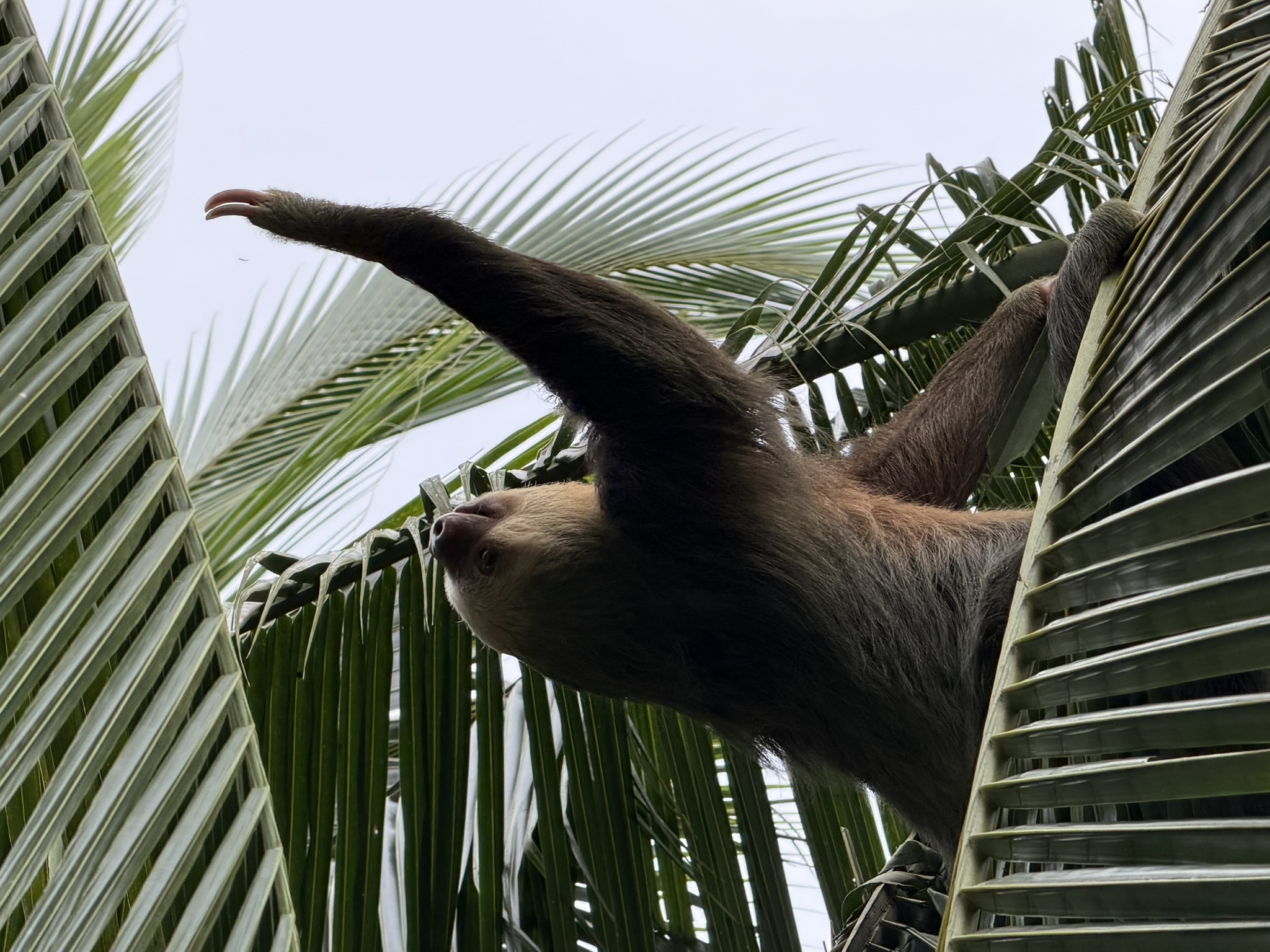
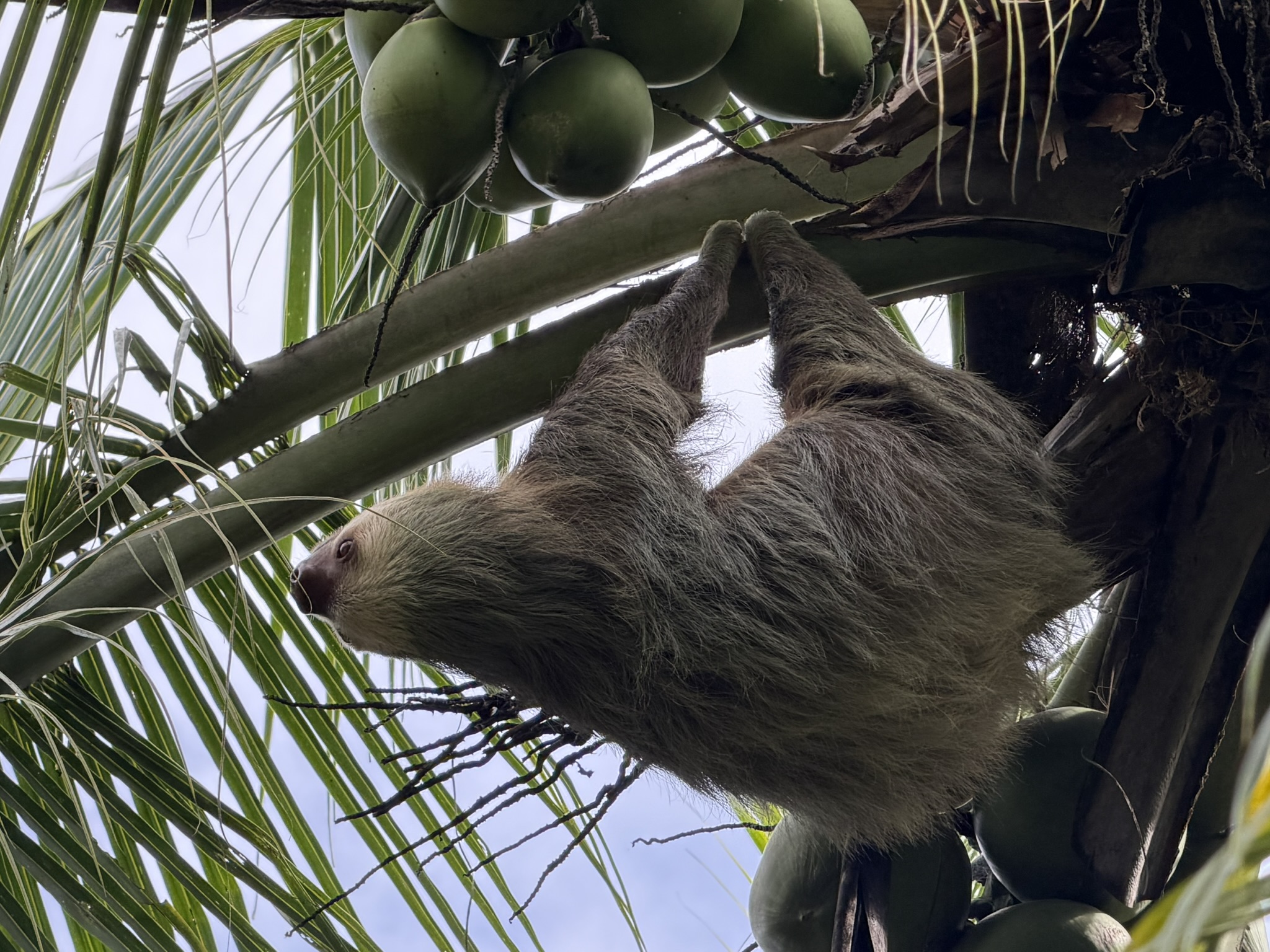
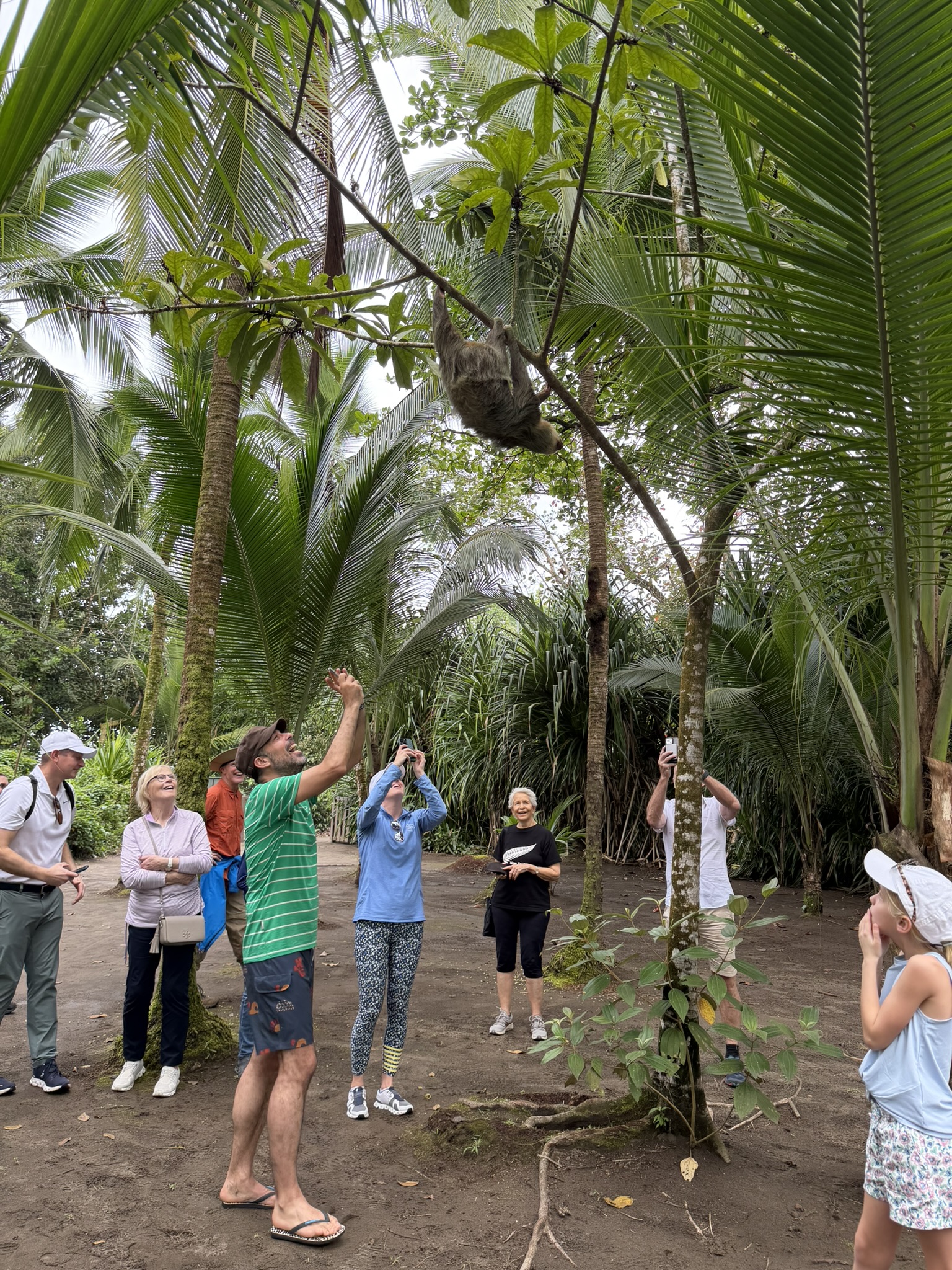
After our orientation walk, a few of us walked via the ocean beach (too wild to swim in) to the sea turtle conservancy, a small museum where we could learn about the turtles. As we entered the conservancy’s grounds, we immediately noticed a sloth moving through the coconut palm trees, just above our heads and alarmingly low to the ground. It seemed odd that it was climbing on the palm fronds, which didn’t seem to be strong enough to bear the weight of a sloth. A conservancy worker emerged, and she shared that it was indeed odd to see a sloth navigating the coconut trees.
The sloth, who we guessed was a female for no real reason, was exerting a lot of effort trying to move between trees, reaching so far, and sometimes missing. But eventually she would grab the next set of leaves and feel balanced enough to transfer to the next tree.
Pedro from Portugal, whose personality usually tended toward standoffish and cool, lit up like a school child in excitement, filming nonstop as he stood right under the sloth. We joked that he should be prepared to catch her if she fell – it seemed like that was a possibility at times.
Where was she going? She was on a mission to get somewhere. And then, when she had navigated several trees over, she turned around and went right back the way she came from! We guessed that she might have been looking for her good tree (not a coconut tree), which she eventually made it back to in the other direction.
We left as some other small groups trickled in. I think we watched her for a good 45 minutes. The turtle conservancy was a good little museum and learning experience, but it didn’t hold a candle to our sloth sighting.
The Others
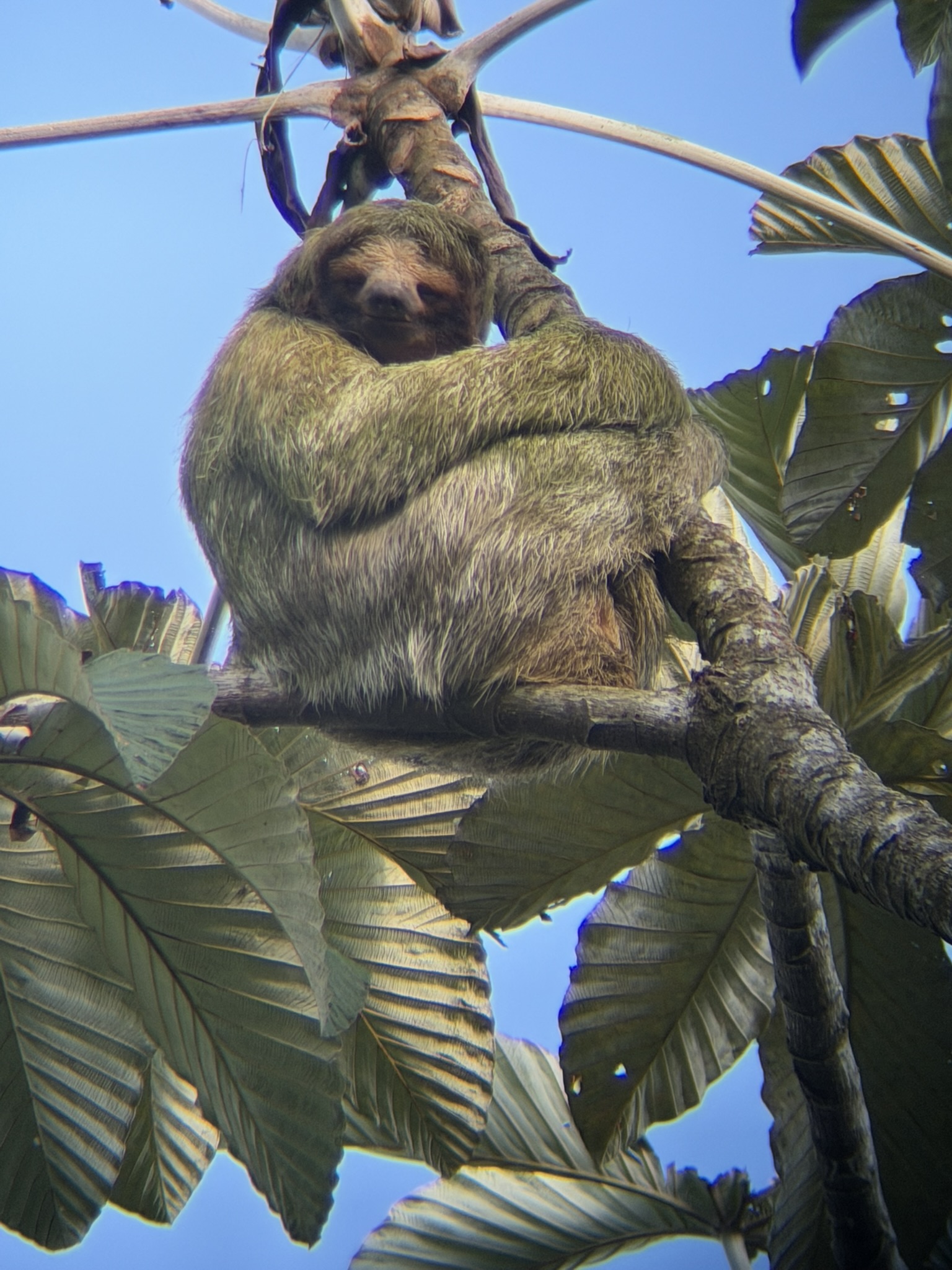
At a certain point, it was just another sloth sighting, though it always had at least a tinge of excitement. In Sarapiqui, deep in the jungle, we went on a bird watching tour, and our guide Vinny found a far-off sloth in a tree. With his telescope zoomed in, he made a whistling sound that caused the sloth to jolt up a little and look at us. I was a bit concerned we were disturbing it, but he claimed it was fine. A hilarious highlight of that walk was when Christina from Portugal lost her shoe in knee-deep mud. It was funny and didn’t deter us.
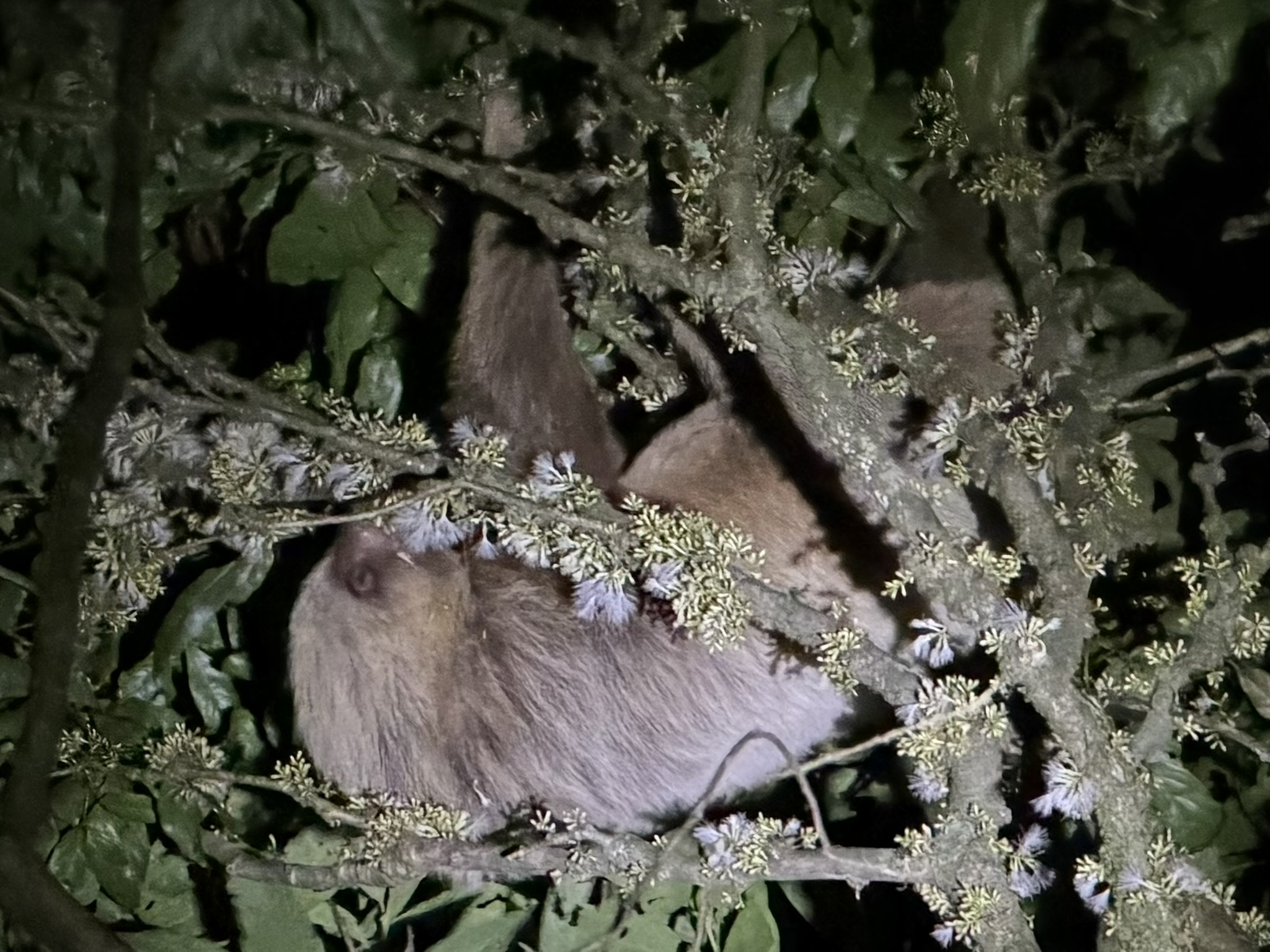
In the Monteverde cloud forest, we went on a night walk, with our guide Fabian identifying lots of creepy crawly animals like scorpions, tarantulas, and a snake that he identified as “only poisonous if you are allergic to it,” which did not lend much confidence. We also spotted a racoon and several snoozing toucans with bright yellow beaks. And then, his flashlight shone on a large, fluffy sloth next to our trail. This one was moving around a little and eating something, and was a different kind of nocturnal species.
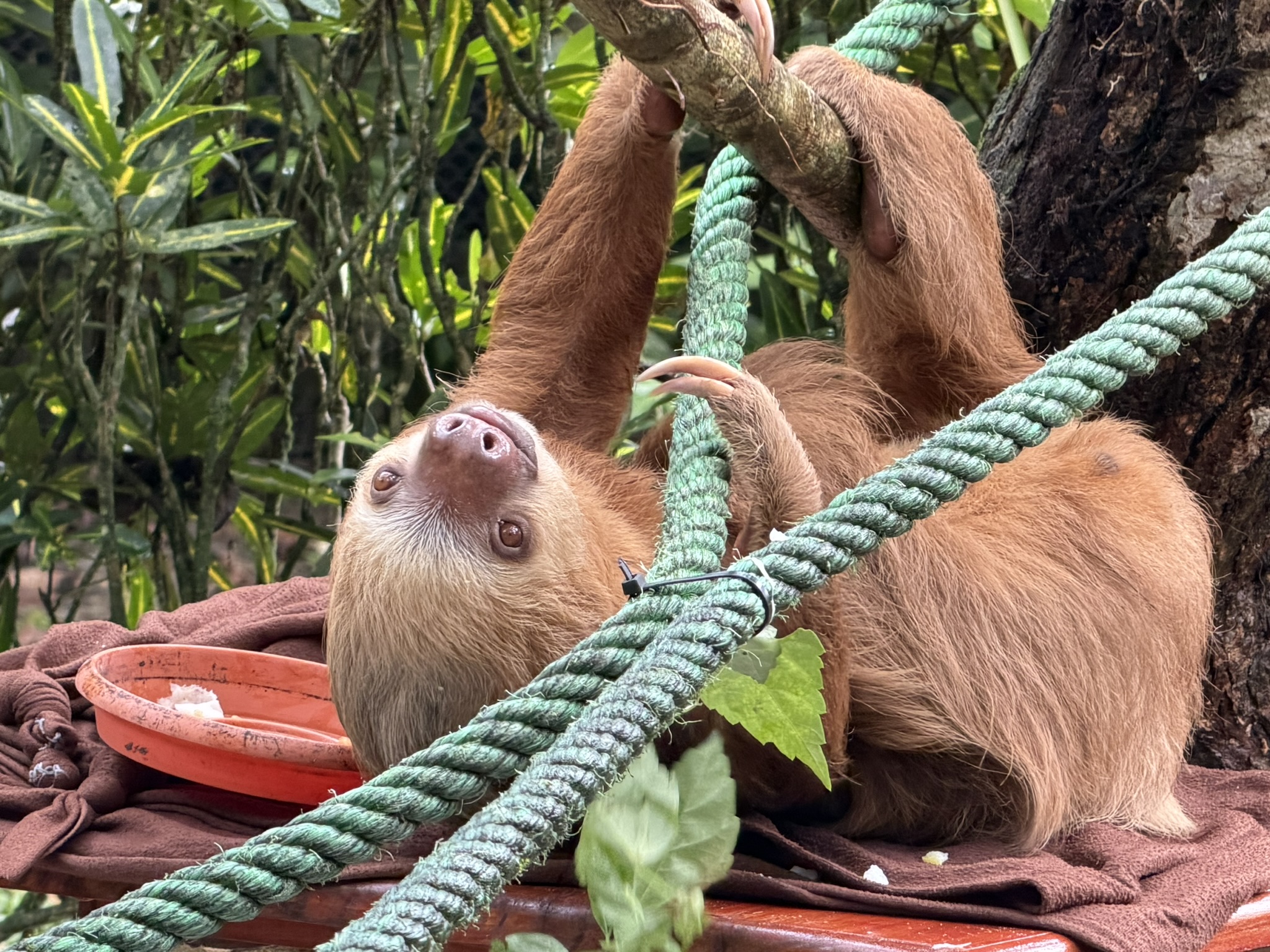
In Puerto Viejo, a popular beach town on the Caribbean coast, we visited the Jaguar Rescue Center, which despite its name was void of jaguars but chock full of lots of other native animals who had been injured or couldn’t live in the wild (for example, ducks that had imprinted on chickens instead of other ducks and now didn’t know they were ducks). Zoos are illegal in Costa Rica, as is taking pictures with animals (I learned after earlier in the trip trying to take a selfie with a monkey). But here, we got up close views and got to learn about spider monkeys, white tailed deer, red and green macaws, parrots, toucans, peccaries, agouti, boobies, storks, caimans, and more. And of course, a couple of adorable sloths in an open-air pen, where we could watch them very close-up as they climbed and munched on carrots; reportedly very active after the recent rainstorm.
At the end of our tour, the woman who founded the center came by with a crate full of four baby howler monkeys, clad in diapers with holes for their tails. It was one of the cutest things I ever saw; it was sad she wouldn’t let us take photos, but I was honestly too mesmerized by them to notice.
Zozo
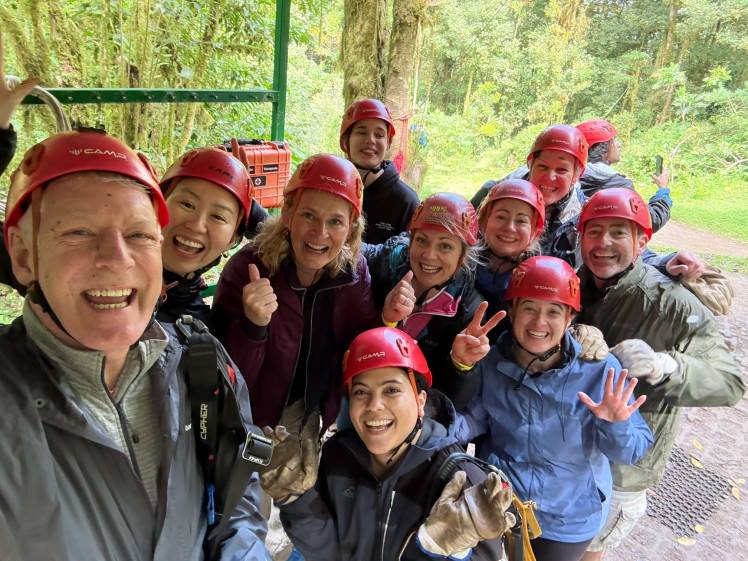
And then there was Zozo. She took a while to name, eventually settling into an abbreviation for the Spanish name for sloth, perezoso, which aptly translates to the word “lazy.” I met Zozo in Monteverde, the windy and chilly cloud forest in the north of the country. I had just had a wild ziplining adventure, where I soared high over the treetops through an ominous on-and-off drizzle. The longest wire was about a mile, and one allowed me to go head-first in a “superman” pose. It was exhilarating.
Then for the last activity of the course, I found myself in one of the most terrified moments of my life. The guides had casually mentioned an optional “tarzan swing.” They didn’t explain what it actually was: first, I walked a narrow green metal bridge over an abyss, which abruptly ended mid-air with a closed waist-high gate, a 50-foot drop to the ground below. Two waiting men encouraged me to do it, and despite fear literally gripping my body to stay holding onto the bridge, they opened the gate, strapped me in, and I stepped off the edge. The first second of freefall without feeling the rope catch me was so scary, and as I started to swing down and back up, I let out an uncontrolled, guttural yell. I swung back and forth a few times, starting to calm down and trust the ropes, until a man at the bottom helped me stop and fall to the ground. My entire body was shaking for a good 15 minutes, while I waited for the other members of my group to join me at the bottom. Watching their own terrified reactions was a bonding experience. We took many selfies at the bottom and then hiked back to the starting location, my hands still shaking as the adrenaline took its time leaving my system.
Back at the top, I walked around the gift shop and instinctively grabbed a stuffed sloth, holding it close to my chest and trying to calm my frayed nerves. As we gathered around getting ready to leave, I said “I am buying this” and went and made the best $35 purchase of my trip. Zozo was a little big for my luggage, but fit in my daypack and became a constant companion for me and my roommate Inga from Germany. Though I felt a little silly buying myself a stuffed animal, it seemed to bring my tourmates joy. One older man, John from California, even said, “That’s the great thing about being an adult, you can just buy whatever you want with no justification.” Ha.
Zozo came home with me and serves as a reminder of the adventure and how I conquered my fears, while her eyes-half-closed smile simultaneously lulls me into my own laziness.

And so, sloth, now that I’ve met you and experienced your local habitat and culture, all I’ve got is more appreciation. While life often moves at a fast pace, you are there to remind me to chill out; to feel the joy in watching a slow-moving animal navigate coconut trees for almost an hour just for the sake of curiosity. Sloth, you inspired me to embrace pura vida – pure life – the spirit of Costa Rica. I like to think I brought a bit of that spirit back home with me.
 travels.of.tara