Mexico City’s Dia de Los Muertos holiday taught me a new way to process death: through joy.

As someone who grew up in the U.S., celebrating the dead and finding true happiness in their memories is not the way I was taught to grieve. No: death is supposed to be finite and sad. But things are a little different in Mexico City, and after spending a few days immersed in the Dia de los Muertos holiday, I began to feel some healing; a lifting of the emotional weight I’d been carrying, placed there by the specter of death.
For weeks in late October, Mexico City transforms into a sea of orange marigolds and skeleton décor, offering a colorful, celebratory feast for the senses in honor of Dia de los Muertos, or Day of the Dead. Culminating on November 1 and 2, the holiday is a time for the spirits of deceased relatives to visit the world of the living.
On display everywhere are artfully arranged “ofrendas,” which are tiered structures with offerings for the decreased. In homes, photographs of dead relatives complete the small arrangements, and marigold petals drift out into the hallways to light the way for the spirits to visit. Outside, the city invests in the holiday big-time, with parades, festivals, performances, face painting, and the brightest colored art displayed everywhere you look, including, when I was there in 2023, a 60-foot tall skeleton display celebrating the Mexican Revolution in the Centro Historico district’s main Zocalo square. It was one of the most joyful and uplifting things I’d ever experienced.
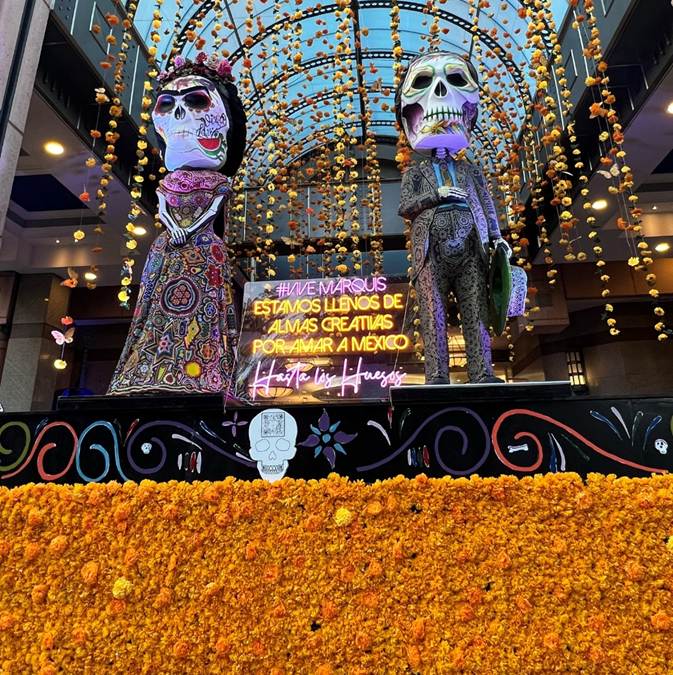
Still, it took me some time to fully embrace the spirit of the Dia de los Muertos festivities, a holiday that is so deeply defined by its emotional heart; by its contrast between external stimulus and internal processing. After several days of adjusting to the excitement, I finally began to turn inward at the home of one of the most well-known artists of all time, Frida Kahlo.
Kahlo’s famously deep blue house in the Coyoacán neighborhood is now a museum, where I was able to revel in meaningful items like her childhood bed and ornate pottery. As I exited into her courtyard garden, I was immersed in green plant life and encased by the boldest, bluest paint color that I still have dreams about today.
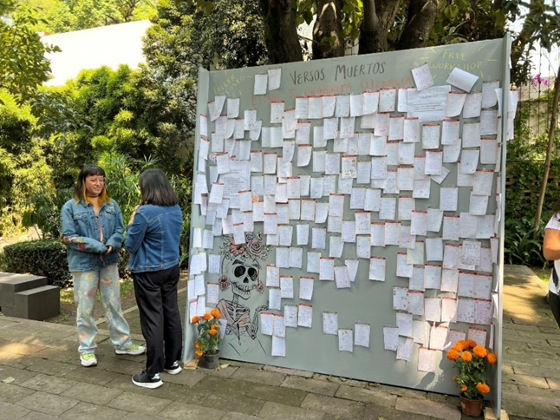
Some young women were stationed at the edge of the courtyard, beckoning visitors to have a seat and participate in a community art project in celebration of the holiday. The assignment: write a message to display on a board in the courtyard written from the perspective of La Catrina—the well-dressed female skeleton that has become a mascot of Dia de los Muertos.
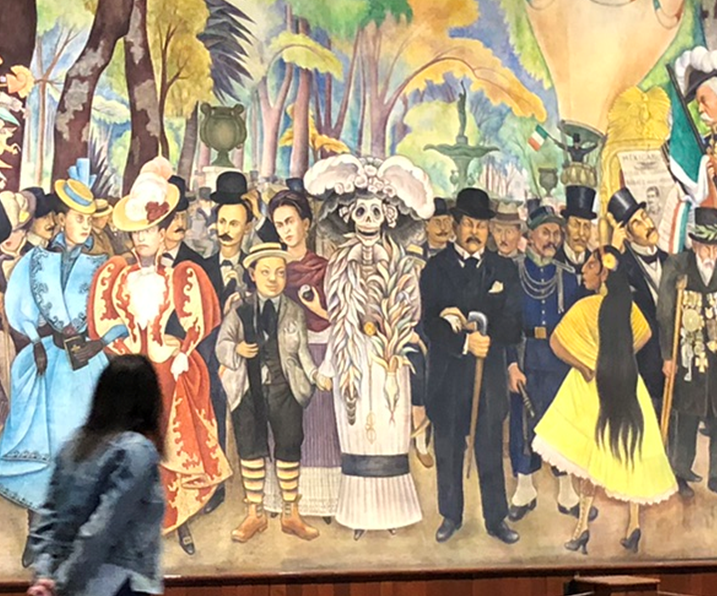
La Catrina was designed in the early 1900s as a nod to an Aztec belief in a goddess of death that took care of the afterlife, while dressed as a caricature of wealthy women of that time. La Catrina has inspired popular holiday traditions, like face-painting skeleton makeup and “sugar skull” decorations. She also had a special connection to my location: Diego Rivera, Frida Kahlo’s husband, painted La Catrina next to Kahlo in his 1947 mural, Dream of a Sunday Afternoon in Alameda Park, which I was able to see on display in Centro Historico. I wonder what they were doing there together.
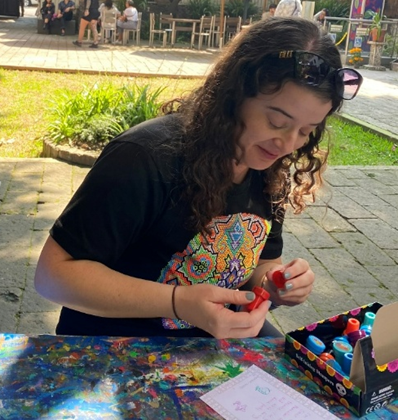
I sat down and took the assignment seriously, reflecting on recent deaths of old acquaintances that had shook me, the long-ago passing of close relatives, and more deeply, my two lifelong friends who had recently completed breast cancer treatment, narrowly avoiding a similar fate and leaving me reeling from a very difficult year. Though the exercise was serious, I felt delighted as I shared a little piece of my creativity in a space that oozed historic art and inspiration.
And so, sitting in Frida’s peaceful courtyard, at a table covered in paint splotches, I wrote:
When life gets disrupted,
and you grieve for all that has changed,
I’m here to remind you,
Savor the memories.
Remember the joy.
Because I’ve got them.
And we’re having a dance party.
I’m not a religious person and I never really thought about there being life after death. While I still don’t believe there is a sassy woman in a big skirt taking care of my loved ones’ spirits, the idea of La Catrina did bring me some comfort. I thought she’d be organizing a dance party.
 travels.of.tara