“Your technique is…interesting” the guide said to me playfully, as I reached the bottom of the Ribeira dos Caldeirões waterfall and clumsily collapsed into the refreshing water. It was my first time rappelling down a cliff, so it wasn’t like I knew what I was doing. Now I know: it’s not like the climbing gym where you casually hop down; here, on the slippery rock face, you want to cautiously walk down, toes first. After those few hours canyoning in the Azores, now I’m basically a pro; and with the taste of adrenaline lingering in my bones I’m ready for more.
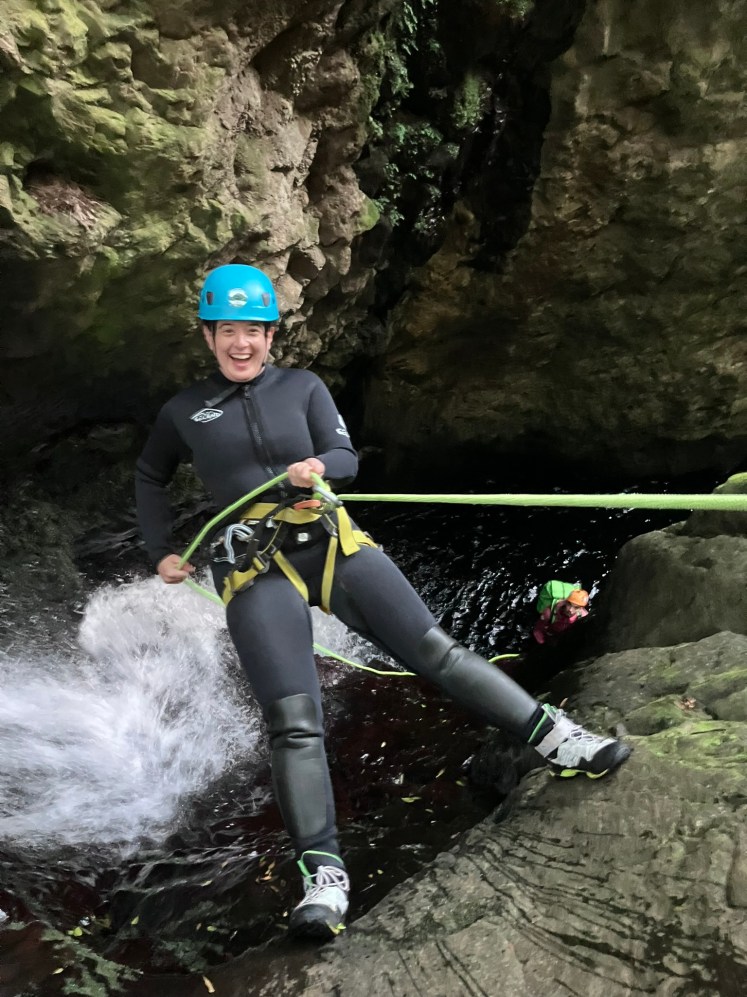
Canyoning is the experience of rappelling, jumping, swimming, and otherwise navigating along a gorge. I’d been intrigued by the idea for years, since I first saw people walking backwards down a tall cliff face in a U.S. National Park, seemingly defying gravity while secured by ropes. I liked the idea of pushing my limits and taking risks, something I wasn’t naturally prone to do.
The stars finally aligned in the Azores, a magical paradise in the middle of the Atlantic Ocean where I spent two weeks solo-traveling in late summer. The group of nine islands, technically part of Portugal but isolated by a 900-mile stretch to the nearest coast, had been calling me since a friend visited two summers ago. As a fellow adventurer, she spoke highly of its magnificent nature–offering a volcanic yet lush landscape that she described as a hiker’s dream–plus its easy accessibility for New Yorkers with just a 5-hour flight.
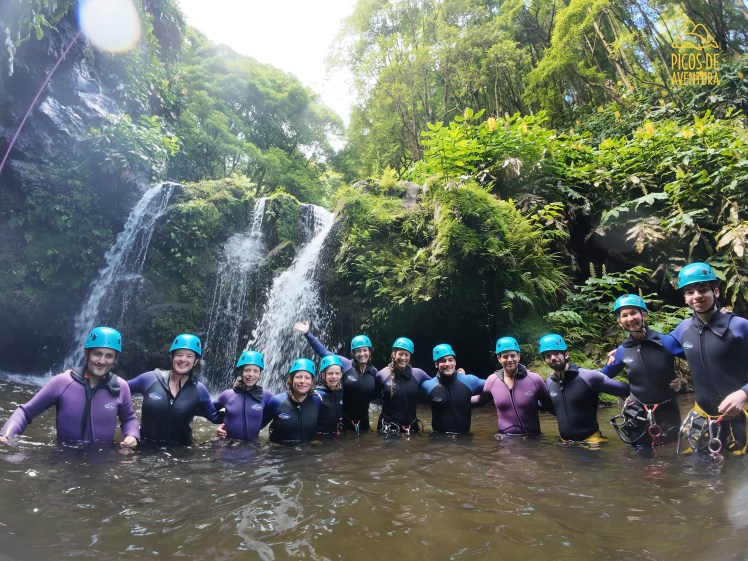
I booked two canyoning tours on two islands to maximize my adventure. First, on the largest and most populated island of Sao Miguel, I met my two guides and group of 11 in a paved parking area right next to one of the most jaw-dropping waterfalls I’ve ever seen – 80 feet tall and structured on the exposed hillside, surrounded by a garden of the island’s famous blooming blue and pink hydrangeas.
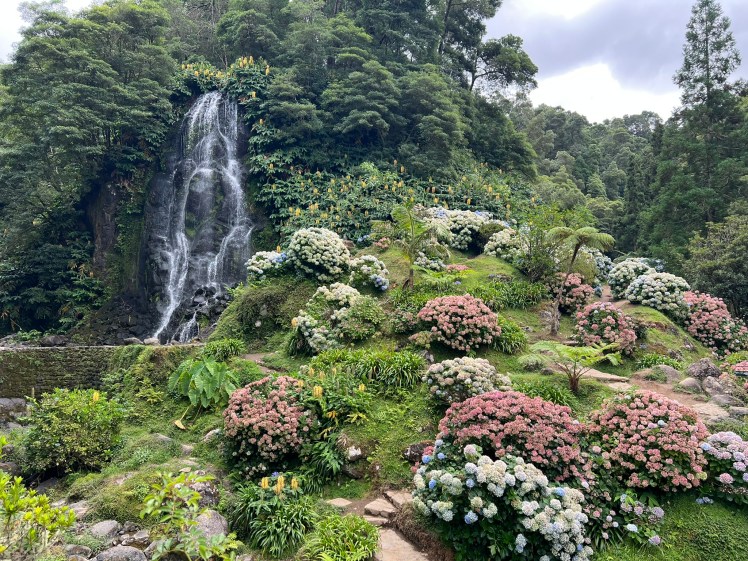
The first task was gearing up in the parking lot: we were given stretchy shirts to put over our bathing suits, wetsuits, neoprene socks and booties, harnesses with heavy dangling carabiners, and helmets. We began a steep hike into the muddy jungle, passing through a thick field of wild yellow flowers that grew in vertical bunches larger than my head, which also made the air smell intoxicatingly sweet. Our guide, Leo, told us that native Azoreans hate them because they are invasive and grow extremely quickly, but on the other hand, you could enjoy sucking the sweet nectar out of the stems if you knew where to tear, which he demonstrated and shared.
We stopped for a safety briefing, where we learned some hand motions to communicate over the loud water: a side fist bump to the helmet means “all good;” an X with your forearms means all is not good. The guides made a point of assuring us that they’d never lost anyone. I wasn’t sure if I believed them, as I mentally prepared to trust these strangers with my life. We studied the harnesses and carabiners and were warned to never, ever remove our helmets: “fix your hair now!” the guides joked.
Finally, it was time for the first activity: an abseil, a sort of drop/zipline into a pool beneath a waterfall. These falls were short and narrow, enclosed by a rocky gorge and darkened by the thick tropical canopy. The atmosphere felt more ominous than uplifting. As the bravest few went first, those of us who needed a few minutes stood in the shallow water and exchanged nervous small talk. I made easy friends with the other solo traveler, a Canadian woman about my age who was also nervous but excited, and an Israeli woman and her two young daughters who made everything we were doing look easy. As my turn arrived, my heart was pumping, but I had a smile on my face. And despite letting out a sharp scream as I dropped, I felt incredible in those couple of seconds as I watched the scenery zoom by, until I safely splashed into the water below.
From there it was nonstop adrenaline, as we navigated the stream that had so artfully carved out the smooth rocks that made up the gorge. The 30-foot high cliff jump was my least favorite–I didn’t like the ear pressure after the jump–and rappelling was my favorite, despite my “interesting” technique. Plus, swimming in the cold, dark water in between waterfalls helped with the dripping layers of sweat I’d built up from hiking to the starting point in a hot wetsuit – hardly the ideal hiking gear in a tropical climate. I ended the day feeling strong and proud, grateful to the Azores for satiating my zest for adventure.
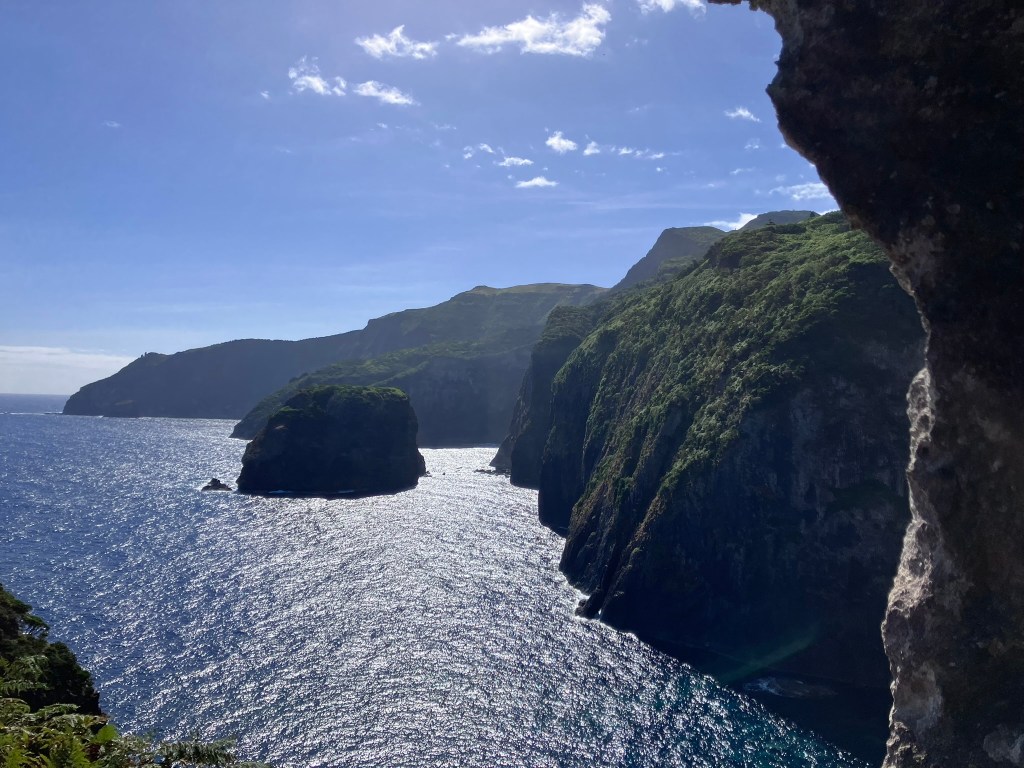
A few days later, I was more than ready to try again, this time on the isolated island of Flores. With a population of just 3,500, Flores was my favorite island of the five that I visited. The landscape featured seaside “fajãs” composed of flat volcanic land large enough for small towns that had formed next to towering green cliffs, with skinny, 300-foot-tall waterfalls casually displaying themselves opposite the rugged ocean coast. With extremely limited food and shopping options—I could not find a postcard or a tourist shop anywhere—the island seemed custom built for nature lovers.
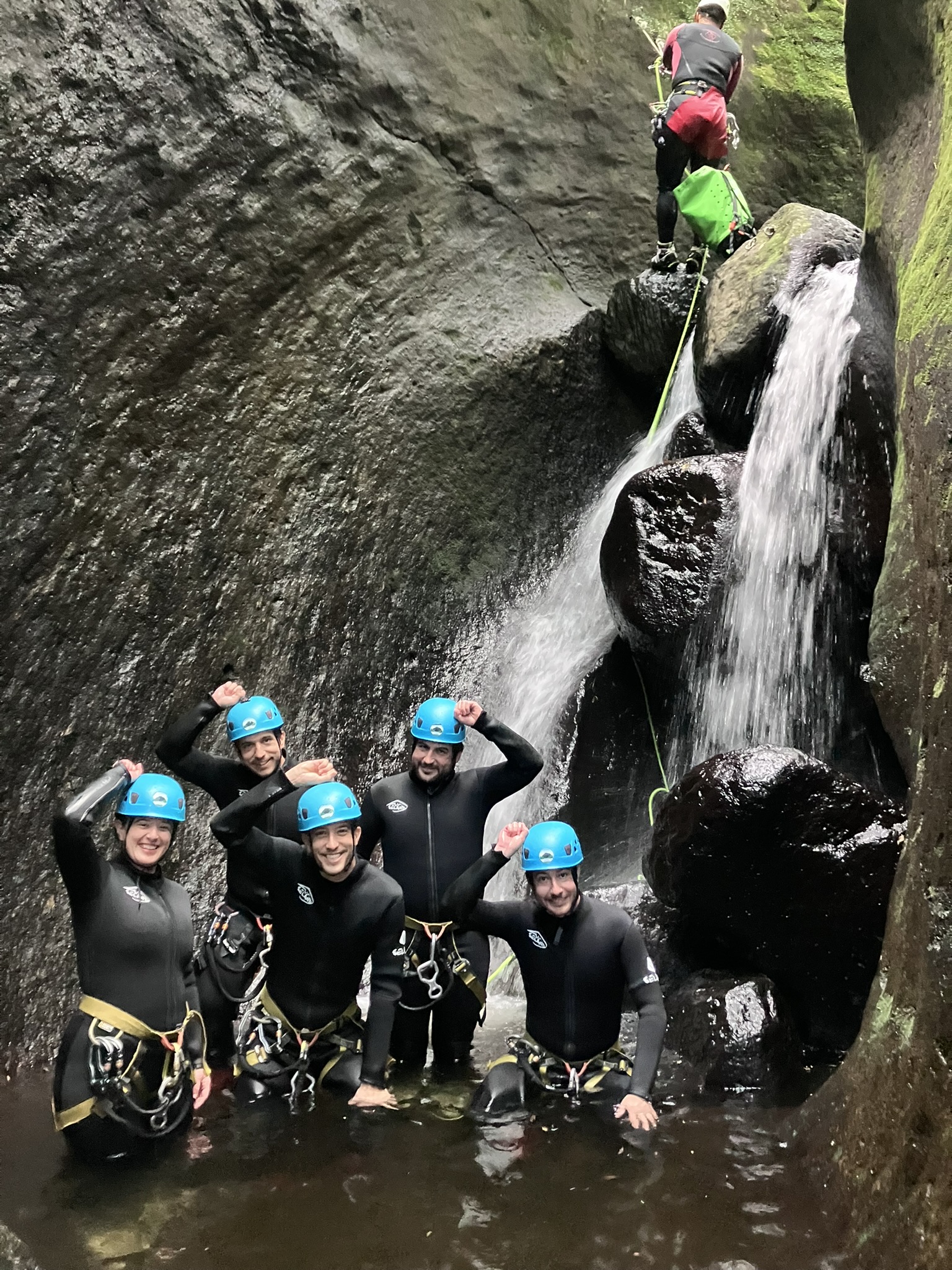
Getting to the Flores canyoning spot at Ihéus Inferior was an adventure in itself. The navigation entailed turning down a hill that felt a little too steep for my tiny rental car, waiting for locals to move their vehicles so I could pass through narrow roads, and heading down a forested dirt road into the middle of nowhere. Arriving at the meet-up coordinates at a trailhead and seeing no one else there felt a little suspicious, but soon others from my group arrived, this time just me and 4 guys from Spain plus two guides.
Once again, we geared up next to the cars. As the only woman in the group, I make a show of going deeper into the woods so I could awkwardly pee around my one-piece swimsuit. We hiked in—I stayed silent as I watched the group walk right next to my fresh puddle—and got our safety briefing. We were encased by tropical jungle, though this time the sense of isolation was palpable and added to the excitement. We did several rappels, the longest one 60 feet high, plus some tall cliff jumps. Any sense of intimidation I felt in being the only woman in the group quickly dissipated, as some of the guys seemed more nervous than me. I was getting the hang of it and building up confidence as I went, trusting that the ropes and the guides had me as I stepped backwards onto the rockface. Though naturally there was some swinging and a little hitting of body parts on rocks – now I know firsthand why they tell us not to remove those helmets!
Swimming through the dark stream as we made our way to the end, I felt a post-adrenaline joyfulness and calm, and noticed the sharp contrast from my normal day-to-day life of sitting at a desk with a natural resting scowl. And as the guides walked us to a final detour, the canopy suddenly cleared to reveal an awe-inspiring coastal viewpoint, the sun illuminating a cerulean blue sea and bright green cliffs. As we all paused in silence to take in the epic view, I felt a wash of gratitude for the soul-filling adventure I had just completed. The Azores had sufficiently satiated my desire to push my limits, and I left the islands feeling empowered.
You’d think I would be tired after all that excitement, but it only fueled my need to embrace nature, so later that day on Flores I found myself swimming in a natural oceanic pool, driving around volcanic crater lakes, and hiking up to two giant cliff-side waterfalls. Perhaps I have no chill, but I’m ok with that. Adventure is calling.
 travels.of.tara