My trip reached peak-epic in Northern Queensland, with Cairns (pronounced “cans”) as my home base. I had two incredible adventures, and honestly words and pictures can hardly capture the experience. I will try my best, starting with my second but more memorable activity in the Great Barrier Reef.
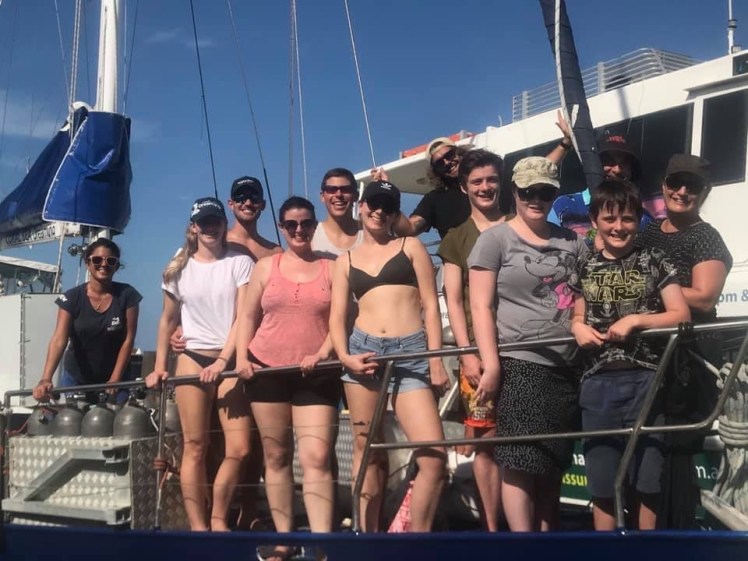
On Tuesday morning I checked out of my hostel, checked my suitcase, and walked to the marina to board the Coral Sea Dreaming, my home for the next two days. I surrendered my shoes and climbed aboard. It was a small boat but comfortable, with a motor and a sail that we never took up. There were just 10 passengers and 3 crew, which made for a very intimate trip. There was a family of 5 from Auckland with kids ages 11, 15, and 17, couple Drake and Maddy and their friend Matt from DC, and Julia from Germany, all in 20s or 30s. Our crew included the captain Christian, a confident man with a hammerhead shark tattoo on his chest who shared stories like when a crocodile nearly chomped off his head; Mike the main dive instructor from New Zealand with beautiful hair and also many animal tattoos, and Carla the other diver from Spain who also managed the food and supplies.
The company puts a lot of effort to warn you that this is not a luxury cruise, and if you are looking for certain comforts you should go elsewhere. A lot of the dive boats on the reef are like that – much bigger and fancier, and also much faster (causing more seasickness, I’ve heard). I initially chose this boat because it was the cheapest I could find and I don’t mind roughing it, but I left feeling like I got so much more out of it being so small. I slept on a very narrow bunk bed with limited floor space, but it ended up being the best sleep I’ve had so far on this trip as the boat rocked me to sleep through the night. It was a blessing that the downstairs was air conditioned. The two bathrooms were comically tiny and flushing the toilet was complicated in the smaller one. We were allowed to shower but were limited to 1-2 minutes to conserve our limited water supply, so I just skipped it. I’m sure we were all smelling pretty ripe by the end, but it was not really noticeable. There was plenty of cushioned seating under an awning on the deck near the captain’s seat, plus places to lay or sit near the front of the boat. The food was like home cooked spreads and dishes and all really good. We drank the same tap water used for everything else and were urged to stay very hydrated; you could also pay for bottled water or sodas or some alcohol in eskies (Australian for coolers).
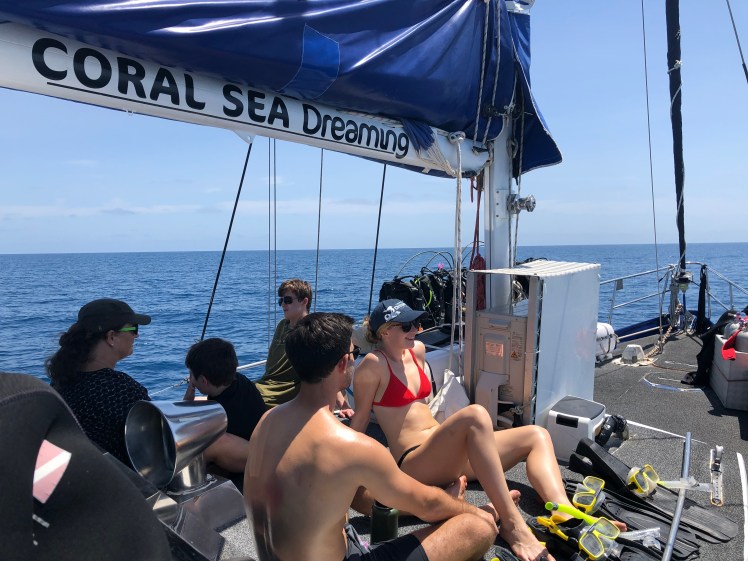


As we left Cairns we saw some beautiful mountainous islands. We were offered seasick tablets, which I took the first day but not the second and was totally fine. It took about 4 hours to get out to the reef at our speed (those other luxury boats do it in 2), but we hardly noticed as it was really beautiful. Eventually we could no longer see any land and it was water all around us. We got lots of safety briefings and dive instructions, and learned there were 2 certified divers (Drake and the 17 year old boy) who get some more freedom in the water and didn’t have to do all the intro work; 4 snorklers from the rest of the family, and 4 first time intro divers. At each of our dive sites Carla would take out the certified divers and Mike would take out 2 intro divers at a time, while Christian would jump in the water on his own for a while sometimes and go exploring.
As we got to the reef the water turned this majestic blue color, close to the crayon color cerulean but even better. The reef water wasn’t deeper than 30 meters (again I’m wondering why America has its own measurement systems), and sometimes from the surface the water looked more teal. It was crystal clear, and the crew were thrilled with the conditions, saying we were lucky to have a great day.
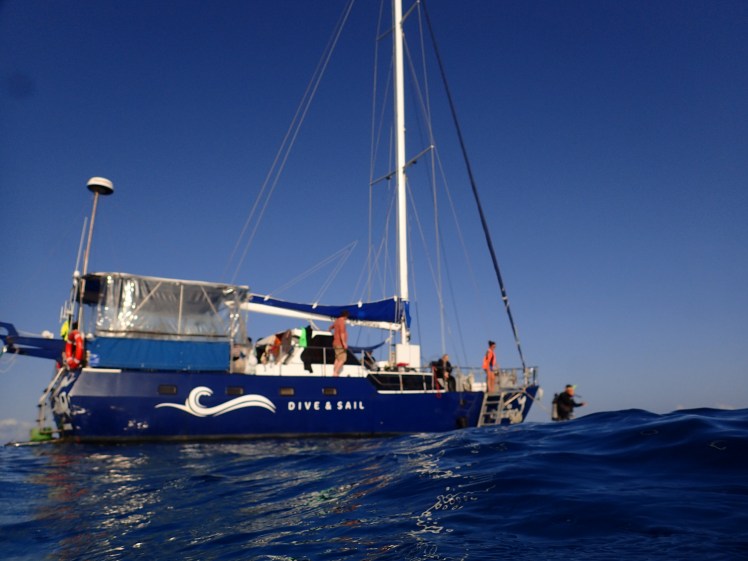
The Great Barrier Reef is not one big reef mass, its lots of little island-like reefs usually covered completely by water that stretch throughout half the east coast of Australia. We went to two sites the first day – Milln Reef and The Edge (where we slept), and two the second day – The Whale and Three Sisters. Not many other boats were around; at times we were totally alone.
I was pretty scared to dive, in part because my ears were still messed up from my last few flights, and I know good ear health is sort of a prerequisite to diving. I told them I wanted to try and see how it went and they agreed. Also, the concept of breathing underwater with all this equipment is just inherently scary. I did it once before, when I was about 16 with my dad and best friend in the Thousand Islands in upstate New York. I remember learning first in a swimming pool and then going to see a shipwreck in the lake, and also how much trouble I had swimming down below the surface.
But I had prepaid for 3 dives to force myself into it, and I gave it a try at the first site. Long and dramatic story short, I did it! I ended up doing two dives, one on each day, and also lots of snorkeling at 3 of the sites, which was just as beautiful. Diving was quite a process. First you have to gear up, including hard-to-put-on wetsuit, mask, and fins (the process for snorkeling stops there, and you just jump in with a buddy and go). Then they clip some weights around your waist and strap you into a backpack with the air tank and all these gauges. It’s extremely heavy to carry around on land. You jump in the water off a platform on the side of the boat (there’s a staircase back up, with a bucket on a rope to send up your fins so you don’t trip). Once in the water you grab on to a rope attached to the boat. The first time you have to pass some “skills” that the instructor teaches you in order to continue. The skills are what to do if your respirator falls out or drops or if your mask fills up with water. I had to use the latter a few times but it was surprisingly easy to clear out. You also learn lots of hand signals for communication (Are you ok/I’m ok, something’s wrong, I want to go up, turtle, shark, clown fish, go that way, etc). You also learn how to equalize your ears as you go by pinching your nose and blowing. Carla told me later that for her that doesn’t always work and yawning/clicking her jaw works better, which was a good tip for me for land and for flying the next day.


As we went deeper down along the rope I started feeling the pressure in my ears pretty bad, and also started panicking a little. I had to go up twice while my dive buddy Julia stayed down, the first time just to take a break and try again, but the second time after passing the skills I was really panicking, heart racing, and was fully ready to chicken out and go back. Fortunately, Mike was so amazing and gave me a pep talk that kept me going – he said “you’re doing it! You passed the skills!” And after a few final deep breaths I was mentally prepared to go for it. I went back down, dealt with the ear pressure, and all of a sudden we let go of the rope and were swimming in open water.
So there I was, breathing underwater. We went together “chicken wing” style, our arms all linked with Mike in the middle and controlling where we went. It was very comforting. We very soon came to the reef and it was BEAUTIFUL. We saw giant colorful fish, lots of different types of coral including some you could see moving like it was breathing, huge sea turtles (one eating, one by the surface later snorkeling), small sharks, giant clams, a Nemo-like orange clown fish, lots of little electric blue Dories, big green and purple parrotfish, big schools of fish who would dart around, and so much more. The colors of the fish and coral were unreal. You would swim right through the fish, sometimes worried you were going to bump into them (but you never did). Julia and I had to be careful not to smile or shout out because the creases in our faces would make the mask fill up. I had so much adrenaline. I was still panicking a little but calmed down as we went and just focused on breathing. At times I thought I needed to stop, but told myself (rightly) that it was all mental and pushed through. My mouth got really dry. When we stayed level my ears were fine, but going up or down just a little was pretty rough. Coming up at the end they popped like crazy, but I could tell it wasn’t permanent damage or anything, and by then I was distracted by what we had just seen. I think we were down about a half hour, but it was hard to tell.
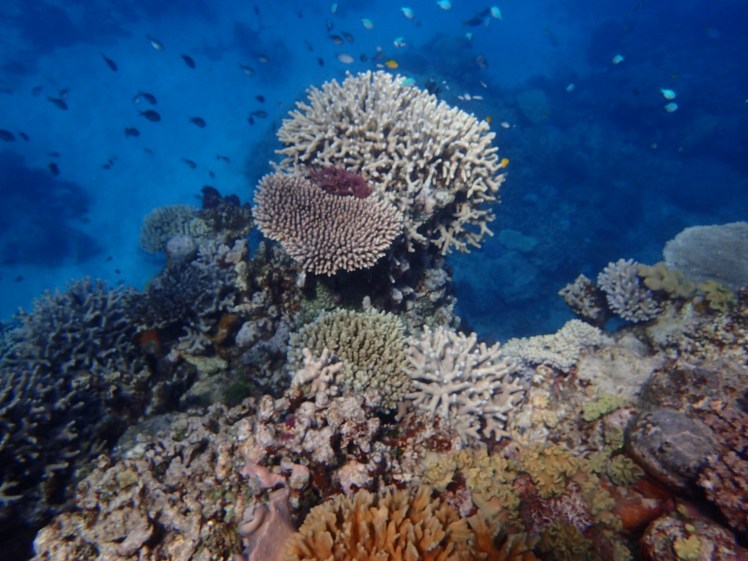
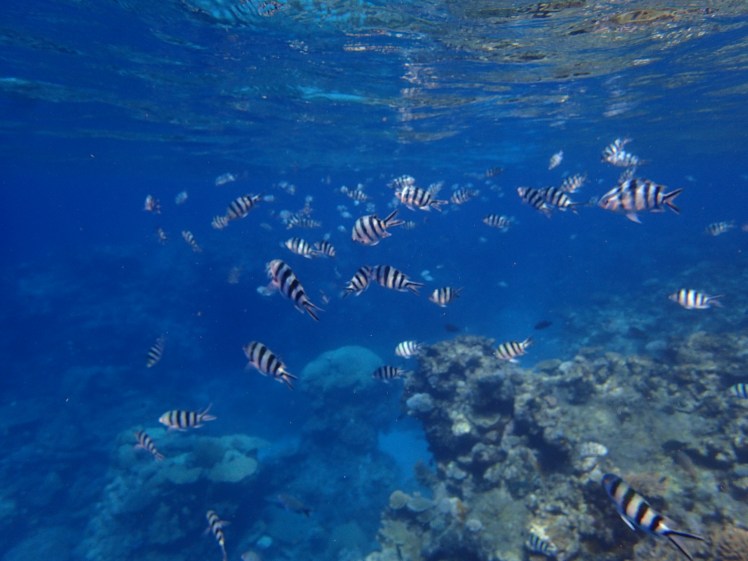


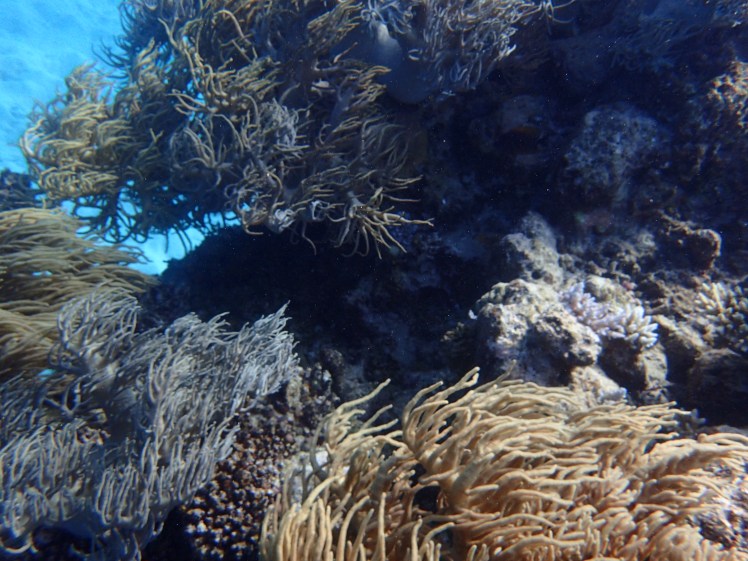
The second dive site was only like an hour or two later, so I opted to skip so I could calm down a little and preserve my ears and I snorkeled instead (Julia did the same). The reef was very close to the surface and you could swim right above it, taking care not to kick anything. It was much easier; and the wetsuits made floating up top really easy. I did get a little nervous when I saw the boat look far away with no one holding on and supervising me, but again, I just put my nerves away and realized I was fine.


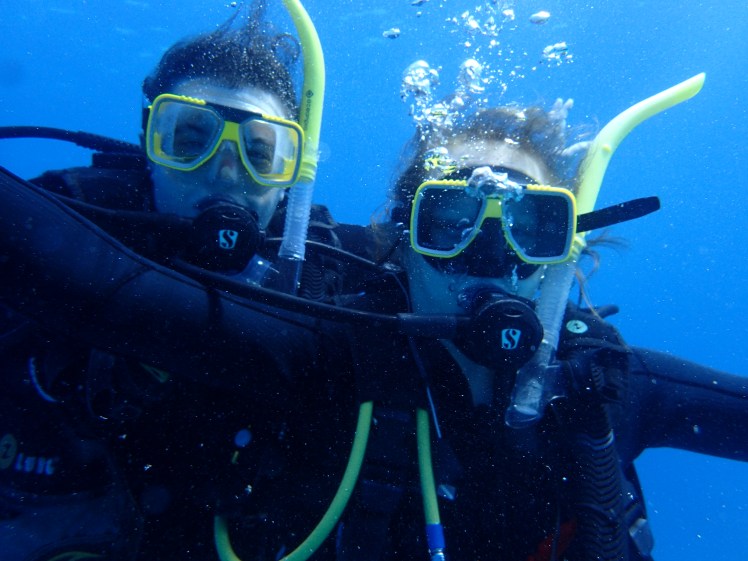
I went on my second dive the next day, and it was much easier. It still hurt my ears about the same amount, but I barely panicked this time. I took it slow going down and up but it was all much quicker to get going. Mike still held on to me and Julia, but at one point he let our arms go and went behind us and held our tanks so our arms were free. This time we also brought the underwater camera we had rented and were sharing and got to take some photos and a few videos, though it was a little tricky to manage. We brought the camera snorkeling at our other sites as well. Julia and I became really close through all this. When we could first speak after the first dive we screamed out about how amazing it was, and once the packs were off we hugged in excitement over conquering a such a challenging but rewarding experience.
The thing I very proactively chose not to do was the night dive. And that was a great decision. Julia and Matt went out with Mike, and Drake went out with Carla. They had little flashlights and we had a floodlight on the boat. The rest of us watched their lights from the boat, and also these sharks that were circling the boat. Lots of sharks. Looking for fish, not people. Apparently the wildlife on the reef are so well-fed because of the thriving ecosystem that you don’t really have to worry about being bitten. You do have to worry about stingers – painful and sometimes deadly jellyfish that are seasonal in the summer months. That’s part of why we had to wear wetsuits even though the water was about 80 degrees. Mike jumped in once very briefly at the beginning and got stung, but he seemed ok after Carla poured vinegar on his back. Anyway, as the night dive ended we heard Christian started yelling a lot at the group, which was now together on a rope he threw out. Apparently the current was extremely strong, and only later after everyone was on board did we find out just how scary it was, as expert Mike said he was struggling to pull everyone back. So, good decision for me not to do that.


The other drama was when Carla slipped down a step that night and slammed her knee, flaring up an old injury. Everyone froze for a few seconds as she curled over in pain, and then I went downstairs to grab Mike (Christian was already asleep) who ran up and took care of her. She was ok but was limping the next day, and Christian took over her diving guide duties. It was very scary but she seemed ok after the fact; she didn’t need a medical evacuation or anything.
As we made the four hour journey back to Cairns we had lots of time to chill out, and we spent some time talking about the ecosystem, climate change, and coral bleaching; all very sad. We got back around 4pm. We took a group photo, I exchanged info with my dive buddy Julia to share our photos (I took home the SD card), and hobbled onto dry land, legs a little shaky post-boat. As I walked back to the hostel I couldn’t believe how amazing and full I felt after that adventure. When I laid down to sleep I felt like I was still rocking on the boat, a phenomenon I’ve felt before after swimming in the ocean. I wished I was still there, dreaming on the coral sea.

 travels.of.tara